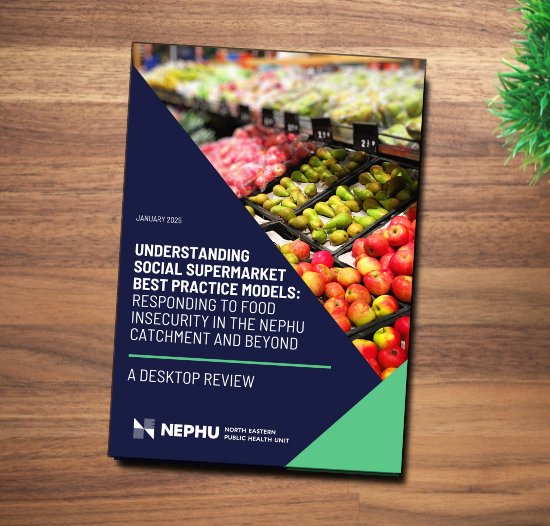
This report explores social supermarket (SSM) models as an alternative approach to tackling food insecurity. Drawing on international and Australian evidence, this report describes the emergence of social supermarkets in Europe and shares insights gleaned through international experience. SSMs currently operating in Australia are also identified.
With more than 3.7 million Australians affected, food insecurity is a significant public health concern. Traditionally, the leading response to food insecurity in Australia has been the direct provision of food relief, however, barriers such as shame and stigma can reduce access for many. This desktop review aims to support stakeholders who may be considering alternative models by providing a snapshot of current evidence on social supermarkets.
Aligned with NEPHU’s ongoing commitment to supporting action on food insecurity, this desktop review was undertaken as part of the 2023-2025 Population Health Catchment Plan. The report explores the characteristics of SSMs and provides some initial insights into feasibility, commenting on enablers, common challenges and limitations of the model.
Key Highlights
- Food insecurity: The report begins by highlighting food insecurity as a significant and growing public health concern in Australia, exacerbated by factors such as the rising cost of living and the recent COVID-19 pandemic. Traditional food relief models may not be accessible to all due to barriers such as shame and stigma.
- Social Supermarkets: Overseas, social supermarkets have emerged as an alternative food relief model that may offer a more dignified, empowering experience for users. In some instances, the policy context has enabled the proliferation of SSMs, for example, in Europe. Meanwhile, in Australia, SSMs are relatively new. This desktop review identified five Australian SSMs currently in operation.
- Model characteristics and challenges: These findings reveal that SSM characteristics vary in four main areas: eligibility; food type, source and pricing strategy; social element; and operations. Common challenges included heavy reliance on volunteer staff and unpredictable food donations, while limitations include a lack of evaluation evidence, particularly in the Australian context.
- Conclusions: Prior to this desktop review, no review of SSMs in the Australian context was available, thus, this work addresses a significant gap and seeks to support stakeholders who may be considering alternative food relief models. While SSMs may offer a valuable, additional, interim strategy for addressing food insecurity, they do not replace the need for upstream efforts to address the underlying causes of this public health issue.
This report was produced by Cate Hentschel, Master of Public Health (MPH) student, University of Melbourne, as part of a student placement (Professional Practice) at the North Eastern Public Health Unit (NEPHU).
Access the full report to explore the findings in detail.