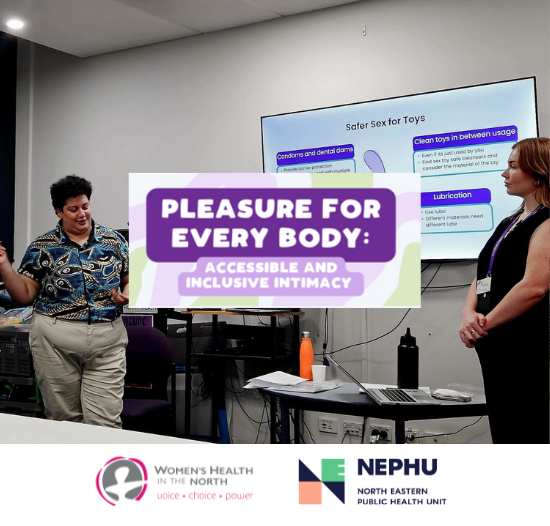
Working in partnership with Women with Disabilities Victoria (WDV), WHIN developed and delivered the ‘Pleasure for Every Body’ program to women and gender diverse people in NEPHU’s catchment.
Combining literature review findings with WDV’s sector and lived experience expertise knowledge, WHIN had identified the need for greater community information and resources focused on sexual pleasure for this cohort, leading to the development of the workshop program.
Project aim:
The ‘Pleasure for Every Body’ program aimed to support women and gender diverse people with disabilities in accessing sexual and reproductive information and services that have a sex-positive and rights-based approach.
Key project aims included:
- Increasing sexual and reproductive health literacy for women and gender diverse people with disabilities.
- Providing access to safe and inclusive sexual and reproductive healthcare.
- Increasing self-advocacy capacity.
- Creating content responsive to community needs and using a strengths-based approach.
By focusing on sexual pleasure, the program was designed to enable participants to counteract shame, stigma and gendered drivers of violence to access safe, positive sexual experiences.
Collaboration and co-design:
As a mainstream health organisation, WHIN’s collaboration with WDV on the ‘Pleasure for Every Body’ project ensured the application of an intersectional lens to program design, with WDV’s expertise helping reduce and eliminate stigma towards people with disabilities, including ableist behaviours and discriminatory system issues.
A series of project meetings were conducted between WHIN and WDV, where community consultation and co-design were conducted to consider community perspectives in the design and development of workshop and resource pack content. By collaborating and prioritising co-design in their program and content design, WHIN ensured that participants were given access to relevant, inclusive and accessible information.
Implementation:
WHIN delivered three workshops for women and gender diverse people with disabilities in Ivanhoe, Coburg, and Preston. A total of 22 community members attended these workshops and took home resource packs with them after attending.
The content of the workshops, designed to respond to community feedback, covered a range of sexual and reproductive health topics with a specific focus on sexual pleasure. Attendees were engaged in content such as pleasure as a sexual and reproductive health right, the impacts of pleasure, consent, sexual scripts, accessible, inclusive and safe sex with sex toys, support services and more.
At the heart of these workshops was an emphasis on accessibility and inclusivity. Intersectionality was key to workshop content while physical accessibility was prioritised through the selection of suitable workshop venues, provision of an AUSLAN interpreter, and no cost to community in attendance. Lived experience was also prioritised through the workshop facilitators and the workshop’s group learning style.
Project outcomes and achievements:
The ‘Pleasure for Every Body’ program had several positive outcomes and achievements with participants describing the workshops as an “open, shame-free discussion about sex, disability and pleasure”.
An evaluation survey was conducted to understand the impact of the program. T This knowledge increase saw participants develop “a better appreciation of how to challenge ableist sexual scripts” and an understanding of “which sexual health services can help me”.
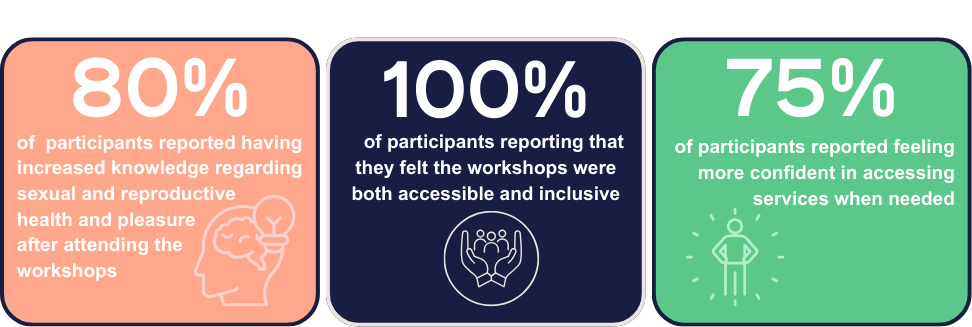
Participants also provided highly positive feedback regarding the inclusivity of the workshops. Attendees described the sessions as “very psychologically safe” and run by “engaging, knowledgeable and respectful facilitators”.
Recommendations for future projects:
From the ‘Pleasure for Every Body’ project, WHIN highlighted several key learnings and recommendations for future projects. WHIN emphasised co-design as best practice within health promotion, highlighting their commitment to building a collaborative relationship with WDV as essential to their delivery of relevant and accessible workshops.
Acknowledgement of accessibility needs as diverse has also been highlighted by WHIN, where various sessions formats, accessible locations, COVID safety and neurodivergent needs should all be considered to ensure project creation and delivery that is inclusive of all needs.
WHIN had also recommended the need for workshops and content such as the ‘Pleasure for Every Body’ project to continue. Communities that can see themselves reflected in sexual and reproductive health information, are able to affirm their sexual and reproductive health rights and increases their own confidence in accessing services and self-advocacy. Workforce development is also needed alongside community support to ensure that services are accessible and inclusive.