
Measles is a highly contagious virus that can cause life-threatening complications.
With new measles cases being reported through both importation from overseas as well as local transmission across Victoria (including exposure sites in the CBD and Fitzroy/Collingwood areas), NEPHU is urging clinicians and community to take proactive actions now.
Measles is a viral disease that can spread easily and can cause serious complications which can include, but is not limited to, respiratory infection and encephalitis.
People who are at higher risk of infection and experiencing serious complications from measles include children younger than 5 years, pregnant women, and people with a weakened immune system.
People who have not previously had measles or been fully immunised (with two measles-containing vaccine doses) are most at risk of becoming infected if exposed.
What are the common symptoms of measles?
Symptoms of measles include fever, runny nose, cough, red eyes, followed by a rash that typically starts on the face and spreads to the rest of the body. The first symptoms take 7-18 days to appear after exposure.
Healthcare professionals should be alert for measles in any patients with compatible symptoms, and isolate, test and notify immediately by telephone on 1300 651 160. Test with a nasal swab for PCR and a serum sample for serology.
People with symptoms of measles should seek medical care and testing, calling ahead to the health service and wearing a face mask.
Who should get vaccinated against measles?
Getting vaccinated is the best way for your patients and community members to be protected from getting infected with measles and spreading it to other people.
- Make sure they have had at least two doses of measles-containing vaccines, usually the measles, mumps, and rubella (MMR) vaccine.
- If they were born in Australia between 1966 – 1994, or were born overseas, its likely they have only had one dose and need a measles booster vaccine.
- Vaccination records are available via Medicare (my.gov.au) or the Australian Immunisation Register (AIR), as well as via personally held records (e.g. babybooks or handheld vaccine cards).
Is it safe to get additional measles (MMR) vaccines?
It is safe to have additional doses of the MMR vaccine.
For people who are not sure if they’ve had their full course of two doses, it is better to get vaccinated to make sure they are protected against measles.
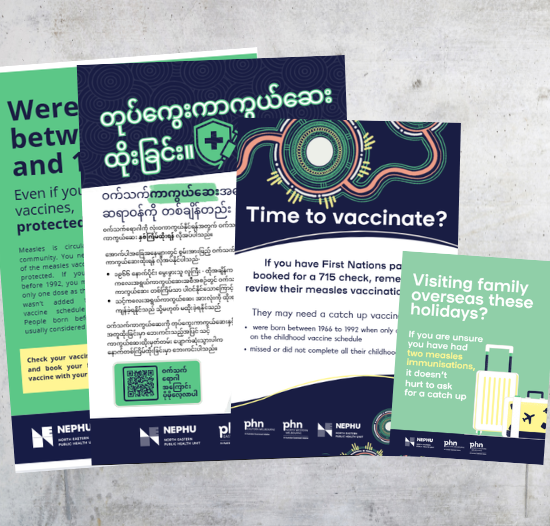
Free catch-up vaccines are available for eligible people (those born after 1965 without two documented doses of measles containing vaccine), and are essential for anyone planning to travel overseas to countries with measles outbreaks.
Children receive a measles-containing vaccine at 12 and 18 months of age as part of the routine National Immunisation Program. Parents and/or carers of babies aged 6 to 12 months are highly recommended to get an extra measles vaccine for their babies before going overseas to high-risk countries.